



Bitcoin traded near $63,700 on Wednesday, Aug. 12, as most major cryptocurrencies edged higher ahead of the July U.S. inflation report.
Summary
- Bitcoin traded near $63,700 early Wednesday as markets waited for the July U.S. inflation release.
- Dogecoin gained nearly 3%, leading major cryptocurrencies, while BNB advanced more than 2% during trading.
- Hyperliquid fell around 1.6%, remaining the only major cryptocurrency besides Bitcoin showing notable weakness Wednesday.
- U.S. Bitcoin ETFs returned to modest inflows Tuesday after Monday ended their five day streak.
- Brent crude approached $90 as geopolitical tensions kept inflation risks elevated before the CPI report.
BTC was down about 0.6% over 24 hours at the time of writing, while Dogecoin and BNB led gains among the largest assets.
The subdued move follows another failed push above $65,000. Bitcoin briefly moved above $65,000 as ETF demand strengthened on Monday. It then fell below $64,000 as oil revived inflation concerns on Tuesday, leaving the market focused on inflation and the Federal Reserve rate outlook.
Bitcoin price stalls while DOGE and BNB lead majors
Dogecoin was the strongest performer among the major cryptocurrencies tracked Wednesday, gaining about 2.9% and trading just above $0.07. BNB followed with a 2% rise to about $614. Ether added 1% to $1,888, XRP rose 0.5% to $1.02 and Solana was nearly flat at $76.
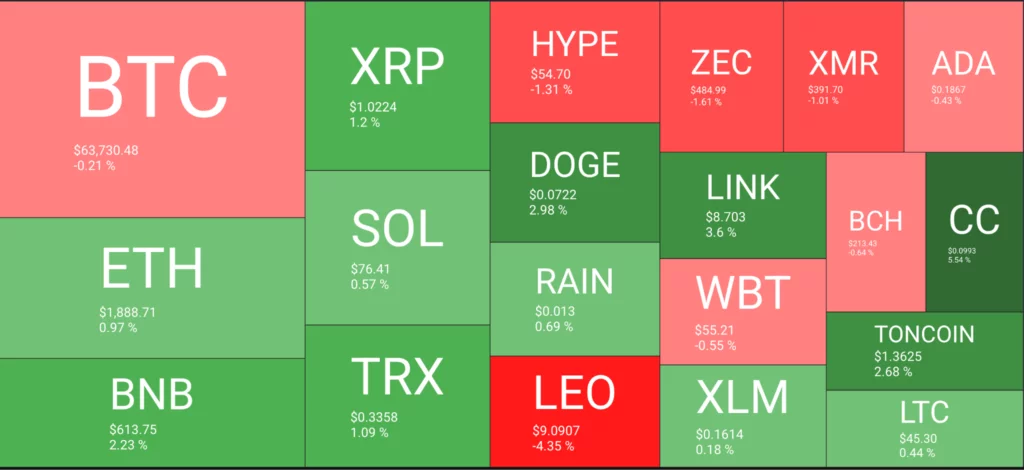
Tron traded around $0.335 after gaining close to 1%, while Chainlink advanced 3.8% to $8.71. Hyperliquid moved in the opposite direction, falling 1% to $54.7. Cardano was also weaker, losing about 1.8%. The mixed performance left altcoins generally firmer than Bitcoin without producing a broad market surge.
Bitcoin’s 24 hour range remained relatively tight between roughly $63,200 and $64,414. The asset has repeatedly tested the $65,000 area over recent sessions but has yet to establish support above it.
Top gainers and losers show selective risk taking
Moves outside the largest cryptocurrencies were much wider. CoinGecko’s latest data, covering its top 1,000 assets with more than $50,000 in daily volume, showed Arowana leading gainers with an 87.7% rise. Prom followed at 36.8%, while aPriori gained 27.2%.
Tutorial led the losses, falling 45.4%. SkyAI declined 28.6%, Biconomy dropped 27.6%, DAPPOS lost 27% and Ravencoin fell 23.6%. These assets sit well outside the largest cryptocurrencies by market capitalization, making their moves less representative of the broader market.
Among assets currently ranked inside CoinGecko’s top 100 on the same sorted list, Bitway was the strongest gainer shown, rising 14.7% to about $0.214. Lighter was the weakest top 100 name shown, falling 6.6% to $2.31. Both rankings and rolling 24 hour changes can move quickly as prices and market capitalizations change.
U.S. ETF flows turn barely positive before CPI
Institutional flows provided only limited support. U.S. spot Bitcoin ETFs recorded $7.8 million in net inflows on Tuesday, according to Farside data. BlackRock’s IBIT attracted $50.2 million, but withdrawals from several competing products offset most of the gain. Monday had produced a $144.6 million net outflow.
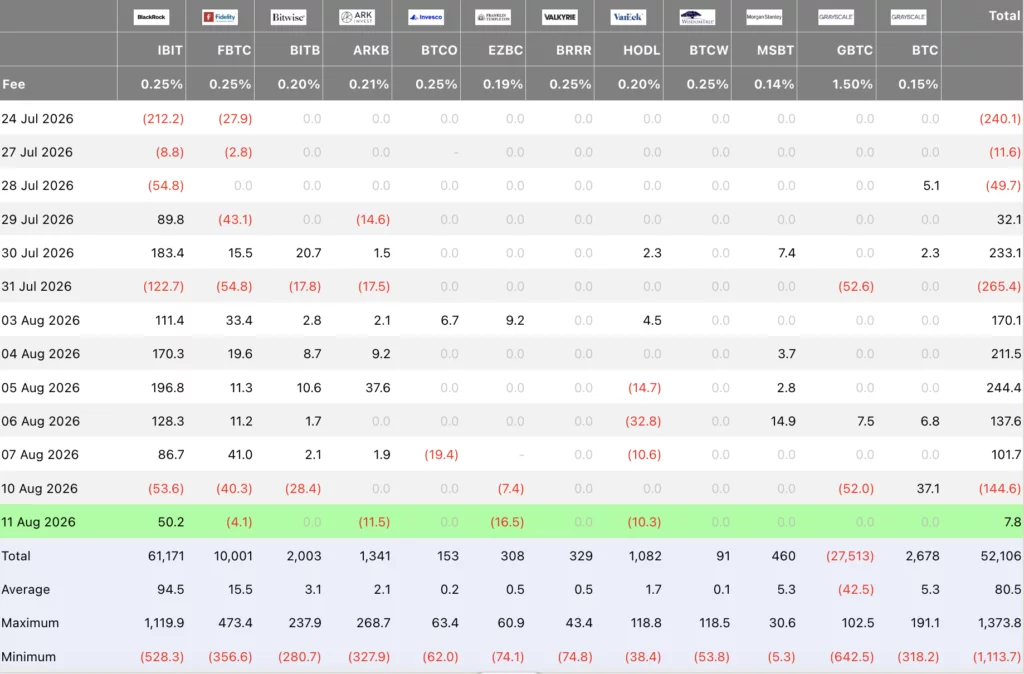
The reversal follows a stronger opening week for August. As previously reported, the funds attracted $853.5 million during five consecutive inflow sessions from Aug. 3 through Aug. 7 using SoSoValue figures. Farside’s dataset puts the same five session total at $865.3 million because the providers use slightly different figures.
Ether funds were softer this week. Farside recorded a $14.6 million net outflow Monday followed by another $1.7 million withdrawal Tuesday. Last week’s stronger demand has therefore not carried into the first two sessions of this week.
Wintermute said in its latest post that renewed ETF buying was encouraging, but added that it would “need to see them continue for a little longer” before becoming more constructive. That remains the market maker’s assessment rather than a forecast of Bitcoin’s next move.
July CPI and $90 oil set the next market test
The next scheduled catalyst arrives at 8:30 a.m. ET Wednesday, when the Bureau of Labor Statistics releases July CPI, according to its official schedule. Economists surveyed by Reuters expect consumer prices to rise 0.1% from June, with annual inflation easing to 3.4%.
Oil is complicating the backdrop. Brent crude rose for a sixth consecutive session and traded near $89.60 to $89.70 a barrel early Wednesday, while U.S. crude climbed to about $83.94. The latest oil increase will not be fully reflected in July CPI, but continued strength could keep future inflation concerns elevated.
The dollar index was near 99.89, while U.S. equity futures were little changed before the inflation release. A softer CPI reading could reinforce expectations that monetary policy need not become tighter, while a hotter reading could revive concerns about another rate increase. Those remain conditional scenarios until the data is published.
Attention then moves to July producer prices on Thursday. The BLS schedule sets the PPI release for Aug. 13 at 8:30 a.m. ET. Until those inflation readings arrive, Bitcoin remains inside its recent range while altcoin strength and ETF demand provide mixed signals about broader risk appetite.
