

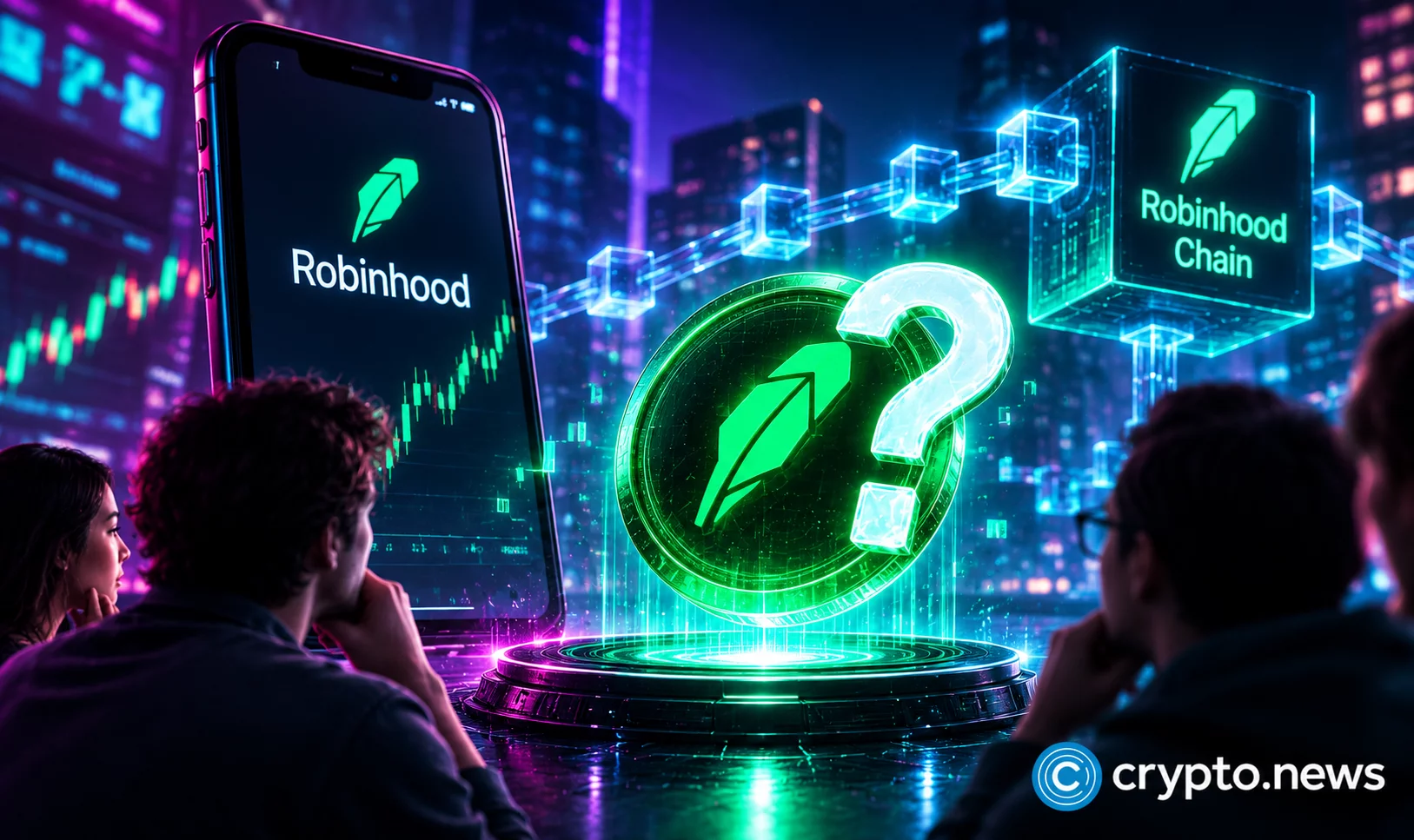
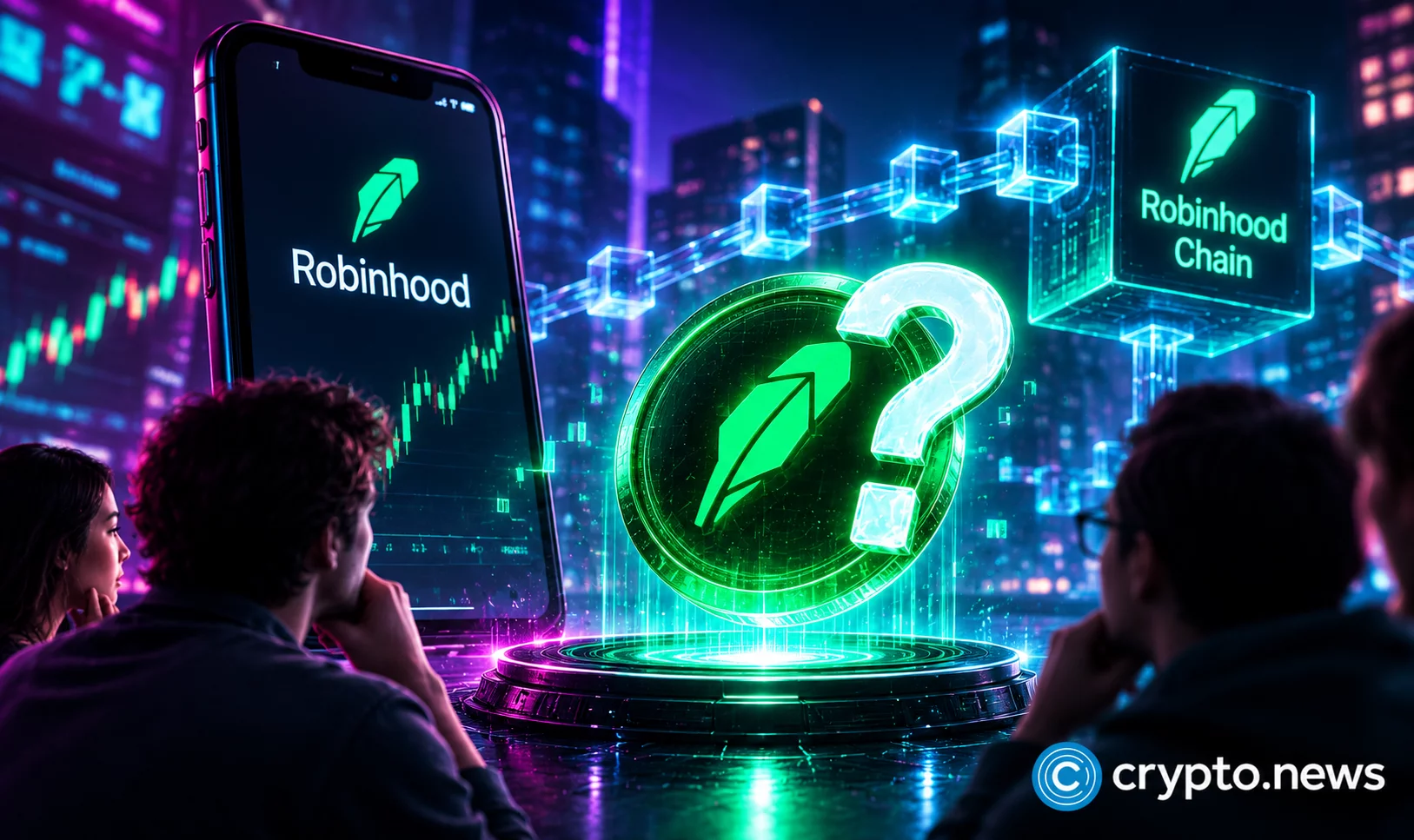
Every dollar Robinhood Chain earns, a tenth goes to a DAO treasury controlled by strangers. The arrangement has been covered a dozen times as good news for Arbitrum’s token.
Summary
- Robinhood Chain runs on Arbitrum’s Orbit stack, and under the Arbitrum Expansion Program every Orbit chain settling outside Arbitrum One routes 10% of net protocol revenue back to the Arbitrum ecosystem.
- The split is fixed: 8% to the Arbitrum DAO treasury, controlled by ARB tokenholders, and 2% to the Arbitrum Developer Guild.
- The figures are now real, no longer theoretical. Robinhood Chain has passed $2 million in cumulative revenue since its July 1 launch, with roughly $200,000 flowing to Arbitrum, and Arbitrum reported the network earning over $800,000 in a single seven-day stretch, annualizing near $42 million.
- The payment is calculated on net revenue after operating costs, applies to sequencer profits, and may extend to MEV capture if the chain adopts Arbitrum’s Timeboost mechanism.
- Every version of this story published so far has been written for ARB holders. The unexamined half is what the arrangement costs the brokerage, and why a company with a $2.2 billion war chest chose to pay it.
Nobody has asked the other question: what a licensed brokerage that spent a decade removing intermediaries bought by becoming a tenant.
There is a particular irony in a company whose entire founding pitch was the removal of intermediaries acquiring one. Robinhood spent a decade telling retail investors that the layers between them and the market were extractive, that commissions were a tax on participation, and that the right architecture was fewer parties taking a cut. On July 1 it launched its own blockchain, the most complete expression of that philosophy available: a settlement layer it controls, sequencing it operates, and fee revenue it collects. And under the terms of the technology stack it chose, a tenth of what that chain nets goes to somebody else. Specifically, 8% goes to a treasury controlled by holders of a governance token, and 2% funds a developer guild, both under an arrangement called the Arbitrum Expansion Program. The mechanism has been reported repeatedly since Offchain Labs disclosed it, always from one direction: what it means for ARB, why the token rallied, how a governance asset acquired a revenue claim. This piece asks the question those pieces did not. What did Robinhood buy, what is it paying, and does the arithmetic work.
What the arrangement actually is
The mechanics are specific enough to matter, and they have been reported loosely in several places.
The Arbitrum Expansion Program applies to any Layer 2 or Layer 3 chain built with Arbitrum’s Orbit toolkit that settles outside Arbitrum One or Arbitrum Nova. Those chains route 10% of net protocol revenue back to the Arbitrum ecosystem. Of that 10%, eight percentage points flow to the Arbitrum DAO treasury, which ARB tokenholders control through governance, and two percentage points fund the Arbitrum Developer Guild, which supports tooling, grants, and protocol work.
Three details in that description carry weight and are frequently dropped.Net, not gross. The calculation runs on revenue remaining after network operating costs, which ties the payment to a chain’s actual profitability instead of raw transaction throughput. That is materially friendlier to an operator than a gross fee would be, and it means a chain running at thin margins pays little regardless of volume.
Sequencer profits are the base. The revenue subject to sharing comes from the entity that orders and processes transactions, which on Robinhood Chain is Robinhood. That is the same revenue line this publication has examined as the core economics of any Layer 2, and it is precisely the line the chain exists to capture.
MEV may be included. If the chain adopts Timeboost, Arbitrum’s mechanism for capturing maximal extractable value from transaction ordering, those revenues could fall under the sharing arrangement as well. Whether Robinhood adopts it is a live question with real dollars attached, since ordering advantages on a chain hosting tokenized equities are worth considerably more than on a memecoin venue.
For contrast, Arbitrum One sends 100% of its own fees to the Arbitrum treasury. The Orbit arrangement is the lighter one, which is the point: it is the price of using the stack without settling on the flagship chain.
The numbers, now that they exist
For the first three weeks this was an abstraction. It is not anymore.
Robinhood Chain has passed $2 million in cumulative revenue since its July 1 launch, with approximately $200,000 routed to the Arbitrum ecosystem under the program. That is a clean 10%, and it is the first hard confirmation that the mechanism operates as described, not as an aspiration in a governance document.
Around that sit the throughput figures that produced it. The chain processed roughly 4 million transactions in its first week. Uniswap alone recorded $500 million in 24-hour volume on it. A single day in early July cleared $568 million. Within about two weeks the chain was clearing more than $800 million in daily decentralized exchange volume, briefly exceeding Ethereum’s, with roughly $3.9 billion across a week. Arbitrum reported the network earning over $800,000 in revenue across seven days, which annualizes near $42 million. Deposits crossed $600 million this week, rising 50% in seven days.
Now the distortion that every honest reading has to apply. The chain is running a 90-day gas subsidy, expiring around October, which means users are not paying the fees a mature chain would charge and the revenue figures are suppressed accordingly. Our audit of the chain’s first month documented how thoroughly that subsidy inflates activity metrics; it works in the opposite direction on revenue. The $42 million annualized figure is therefore both a real number and a floor, and the interesting reading comes after the subsidy lapses, when volumes and revenues both reprice. For broader context, crypto.news has also explained the subsidy distorting these numbers.
At current run rates, Arbitrum’s share is roughly $4 million a year. Against Robinhood’s quarterly revenue near $1.27 billion, that is a rounding error. Against the chain’s own economics, it is a tenth of everything.
What Robinhood bought
The arrangement only looks strange if you assume the alternative was free. It was not, and the alternatives are worth setting out because the choice reveals the strategy.
Build independently. A brokerage could commission a chain from scratch, own 100% of sequencer revenue, and pay nothing to anyone. The cost is time, engineering risk, and security. Rolling your own settlement layer means auditing it, defending it, and answering for it when something breaks, which for a regulated financial institution holding customer assets is not a theoretical exposure. It also means no ecosystem: no existing tooling, no bridges, no wallets that already work.
Use an existing chain. Deploy on Arbitrum One or Base or anywhere else, pay ordinary fees, capture nothing. This is what Robinhood actually did first, launching tokenized stock offerings on Arbitrum in 2025 before committing to its own chain, and the limitation is obvious: you are a tenant with no landlord’s economics and no control over the roadmap, the fee schedule, or who else gets to build next door.
Take the Orbit path. Get a chain you brand, control, and sequence, with Offchain Labs providing technical support, inheriting the Arbitrum ecosystem’s tooling and security assumptions, at the price of a tenth of net revenue. The launch specifications suggest what that bought: 100-millisecond block times, EVM compatibility, ETH as the gas asset instead of a new token nobody asked for, and a chain live and processing millions of transactions within a week of announcement.
Read that way, the 10% is a build-versus-buy decision resolved in favour of speed, and for a public company with a stock to defend and a crypto revenue line that fell 47% year over year in the first quarter, speed was plausibly worth more than margin. Our earnings analysis covered why the timing mattered so much.
The uncomfortable version of the same read is that Robinhood, having concluded that owning the rails is where the value sits, does not actually own them. It leases them, with favourable terms, from a decentralized organization whose token holders vote on what to do with the proceeds.
The tenant problem
That last sentence is not a rhetorical flourish. It describes a governance relationship that no traditional financial infrastructure arrangement resembles, and it has consequences nobody has priced.
The 8% going to the Arbitrum DAO treasury is controlled by ARB tokenholders through governance votes. Those holders decide how the money is deployed. They also, through the same governance process, hold influence over the direction of the technology stack Robinhood’s chain depends on. A licensed brokerage supervised by federal regulators is now a revenue contributor to, and a dependent of, an entity whose decision-making runs through token voting by anonymous participants.
For most crypto-native businesses that is unremarkable. For a public company that files with the SEC, answers to a board, and holds customer assets under regulatory obligation, it is a novel counterparty structure. The questions it raises are practical, not philosophical: what happens if governance votes to change the fee arrangement, what recourse exists if the stack’s roadmap diverges from the tenant’s needs, and how a regulated institution documents dependency on a DAO in its risk disclosures.
There is also a competitive dimension. The Orbit program applies universally, meaning any competitor can take the same path on the same terms. The arrangement Robinhood entered is not exclusive and confers no advantage over the next brokerage to build a chain, which limits how much of a moat the whole exercise creates. What it does create is a template, and the rest of the industry has noticed: our coverage of the tokenized-equity race documented Nasdaq building blockchain share issuance with Kraken’s parent and ICE working with OKX, none of which requires anyone to build from scratch.
Does the arithmetic work
Set aside the framing and ask the commercial question, because the answer determines whether any of this matters.
Roughly $42 million annualized in chain revenue, before the subsidy expires, against $4 million to Arbitrum. Against a company whose quarterly revenue runs near $1.27 billion, the chain contributes something in the low single-digit percentage range of annual revenue at current run rates, and the Arbitrum payment is immaterial to the parent by any measure.
Which means the fee share is not the story financially. It is the story structurally, because it clarifies what the chain actually is. Robinhood did not build a chain to earn sequencer fees; the numbers are too small relative to its brokerage business for that to be the motivation. It built one to control the settlement layer for tokenized equities, to avoid depending on a competitor’s infrastructure as that market develops, and to own the venue where its own products trade. Sequencer revenue is a byproduct, and 10% of a byproduct is a reasonable price for the option.
The test comes when the byproduct stops being small. If tokenized equities scale the way the DTCC’s entry into the same market suggests they might, and if Robinhood Chain hosts a meaningful share of that activity, the sequencer line grows and the 10% grows with it. A tenth of a rounding error is nothing. A tenth of a business is a negotiation, and the Arbitrum Expansion Program’s terms were set by the party that wrote them.
The precedent this sets
Strip out the two companies and the arrangement describes something the industry has been moving toward without naming: infrastructure providers taking a percentage of businesses they do not operate.
Arbitrum’s position under this model is closer to a franchise operator than a blockchain. It supplies the technology, the tooling, the security assumptions, and the developer support, and it collects a percentage of what franchisees earn across an expanding set of chains it did not build. Offchain Labs has been explicit that this is the strategy, framing enterprise adoption as the revenue thesis and noting that the flagship chain’s economics are separate. The model compounds with adoption in a way that grants and one-time licensing never do.
That has an obvious appeal for anyone holding the governance token, and it has a less obvious implication for everyone building on the stack. A percentage arrangement set at launch, when the tenant is small and the terms are generous, is an arrangement that becomes expensive precisely when the tenant succeeds. Ten percent of nothing costs nothing. Ten percent of a settlement layer hosting a meaningful share of tokenized equities is a real line item, and it is collected by a party whose consent the tenant needed at the start and whose terms the tenant did not write.
The comparison from outside crypto is the app store. Developers accepted a percentage when the platform was small and the alternative was no distribution, and spent the following decade in litigation and regulatory complaint about the rate. Nothing about the Arbitrum arrangement is coercive in that way, since alternatives genuinely exist and the terms are public. But the structural shape is familiar, and the history of platform percentages is that they are renegotiated by the largest tenants, eventually, loudly.
Robinhood is now among the largest tenants on this particular platform. Whether it ever behaves like one is a question for the quarter after the subsidy expires, when the numbers stop being small enough to ignore.
What to watch
The revenue line after October. The 90-day gas subsidy expires around then, and the first unsubsidized quarter is the only honest read on what the chain actually earns. Both volumes and revenues reprice, in opposite directions, and the net is unknown.
Whether Timeboost gets adopted. MEV capture on a chain hosting tokenized equities is worth real money, and adopting Arbitrum’s mechanism would likely bring those revenues under the sharing arrangement. The decision is a direct read on how Robinhood values ordering revenue against the cost of sharing it.
Disclosure in the filings. Whether the chain’s economics, including the Arbitrum arrangement, appear in Robinhood’s regulatory filings as a described dependency or a risk factor, and in what language. A public company documenting a revenue-sharing obligation to a DAO would be a first worth reading closely.
Whether the terms hold. The Expansion Program’s rates are set by Arbitrum governance. Any proposal to change them, in either direction, would test how much leverage a large Orbit tenant actually has, and Robinhood is now among the largest.
Competing chains on the same terms. Every brokerage that follows takes the same deal. If the tokenized-equity market fragments across several Orbit chains, the interesting question stops being what Robinhood pays and becomes what Arbitrum collects from an entire category it does not operate.
A final note on why the framing in the existing coverage matters more than it looks. Every account of this arrangement published so far was written for holders of a governance token, which meant the operative question was always whether the revenue share is large enough to justify a rally. That is a legitimate question and it produced accurate reporting. It also produced a blind spot, because a revenue share has two sides and only one of them was ever examined.
The side nobody covered is the one with the public company, the regulatory filings, the customer assets, and the board. Robinhood’s chain is now a material piece of its strategic story, its stock trades on the strength of that story, and the chain’s economics include a permanent obligation to an entity that no securities analyst covering the stock has any reason to have heard of. That gap between how crypto covers a deal and how equity markets would cover the same deal is where most of the useful analysis in this sector currently sits, and it is worth reading every ecosystem announcement with the question of who else is party to it. The same platform-ownership pattern is also visible in the same playbook in prediction markets, where distribution, licensing, and customer ownership intersect.
Frequently asked questions
What is the Arbitrum Expansion Program?
An arrangement under which any Layer 2 or Layer 3 chain built with Arbitrum’s Orbit technology stack, and settling outside Arbitrum One or Nova, routes 10% of its net protocol revenue back to the Arbitrum ecosystem. Of that, 8% goes to the Arbitrum DAO treasury controlled by ARB tokenholders, and 2% funds the Arbitrum Developer Guild.
How much has Robinhood Chain actually paid?
Roughly $200,000, against more than $2 million in cumulative chain revenue since the July 1 launch, which confirms the 10% rate operating in practice. Arbitrum separately reported the network earning over $800,000 in a single seven-day period, annualizing near $42 million, though those figures are suppressed by an ongoing gas subsidy.
Is the 10% calculated on gross or net revenue?
Net, after network operating costs, which ties the payment to a chain’s actual profitability rather than to transaction volume. The revenue base is sequencer profits, and if the chain adopts Arbitrum’s Timeboost mechanism for capturing value from transaction ordering, those revenues may fall under the arrangement as well.
Why did Robinhood not just build its own chain from scratch?
Time, risk, and ecosystem. Building independently means owning all the revenue and also owning the security, auditing, and defence of a settlement layer holding customer-adjacent assets, with no existing tooling, bridges, or wallet support. Orbit delivered a branded, controlled chain with 100-millisecond block times and technical support from Offchain Labs, live within a week, at the cost of a tenth of net revenue.
Does the payment matter financially to Robinhood?
Not currently. At present run rates the Arbitrum share is roughly $4 million a year against quarterly company revenue near $1.27 billion. The chain itself contributes a low single-digit share of annual revenue at best. The arrangement matters structurally rather than financially, because it defines what the chain is and who it depends on.
What is unusual about paying a DAO?
The counterparty structure. The 8% flowing to the Arbitrum DAO treasury is controlled by token holders voting through governance, and those same holders influence the roadmap of the technology stack Robinhood’s chain runs on. A federally regulated public company holding a revenue-sharing obligation to, and infrastructure dependency on, a decentralized organization is a novel arrangement with unsettled disclosure and risk-management questions.
Does this give Robinhood any advantage over competitors?
Not through the arrangement itself, which is available to anyone on identical terms. Any brokerage can build an Orbit chain and pay the same 10%. Robinhood’s advantages, if they hold, come from distribution and from operating the venue where its own products trade, and the tokenized-equity market is already attracting incumbent exchanges building comparable infrastructure.
What should investors watch?
The first unsubsidized quarter after the gas subsidy expires around October, whether Timeboost is adopted and MEV revenue enters the sharing arrangement, how the chain’s economics and the Arbitrum obligation appear in regulatory filings, and any governance proposal to change the Expansion Program’s rates. This is educational analysis, not investment advice.
Disclaimer: This article is for information and educational purposes only and does not constitute financial or investment advice. Revenue figures reflect third-party trackers and company statements available at the time of writing and are subject to revision, and chain activity is currently affected by a temporary fee subsidy. Nothing here is a recommendation to buy, sell, or hold any security or asset. Always do your own research. Information is accurate as of July 29, 2026.
