



Shiba Inu price is forming a double bottom at key high-time-frame support, with value area confluence suggesting downside exhaustion and the potential for a bullish rotation if support holds.
Summary
- SHIB forms a double bottom at key high-time-frame support.
- Support aligns with daily structure and the Value Area Low.
- Reclaiming the Point of Control could trigger a bullish rotation.
The Shiba Inu (SHIB) price is beginning to show early signs of stabilization after a prolonged period of downside pressure, as price action forms a potential double bottom at a critical support level. This area is reinforced by multiple high-time-frame technical confluences, including daily support and the Value Area Low (VAL).
While confirmation is still pending, the structure suggests that selling pressure may be weakening, opening the door for a possible rotational move higher if buyers continue to defend this zone.
Shiba Inu price key technical points
- SHIB forms a double bottom at high-time-frame support, aligned with daily structure and the Value Area Low.
- The pattern suggests downside exhaustion, but confirmation requires further upside acceptance.
- A successful hold opens the path toward the Point of Control and Value Area High, signaling a potential market rotation.
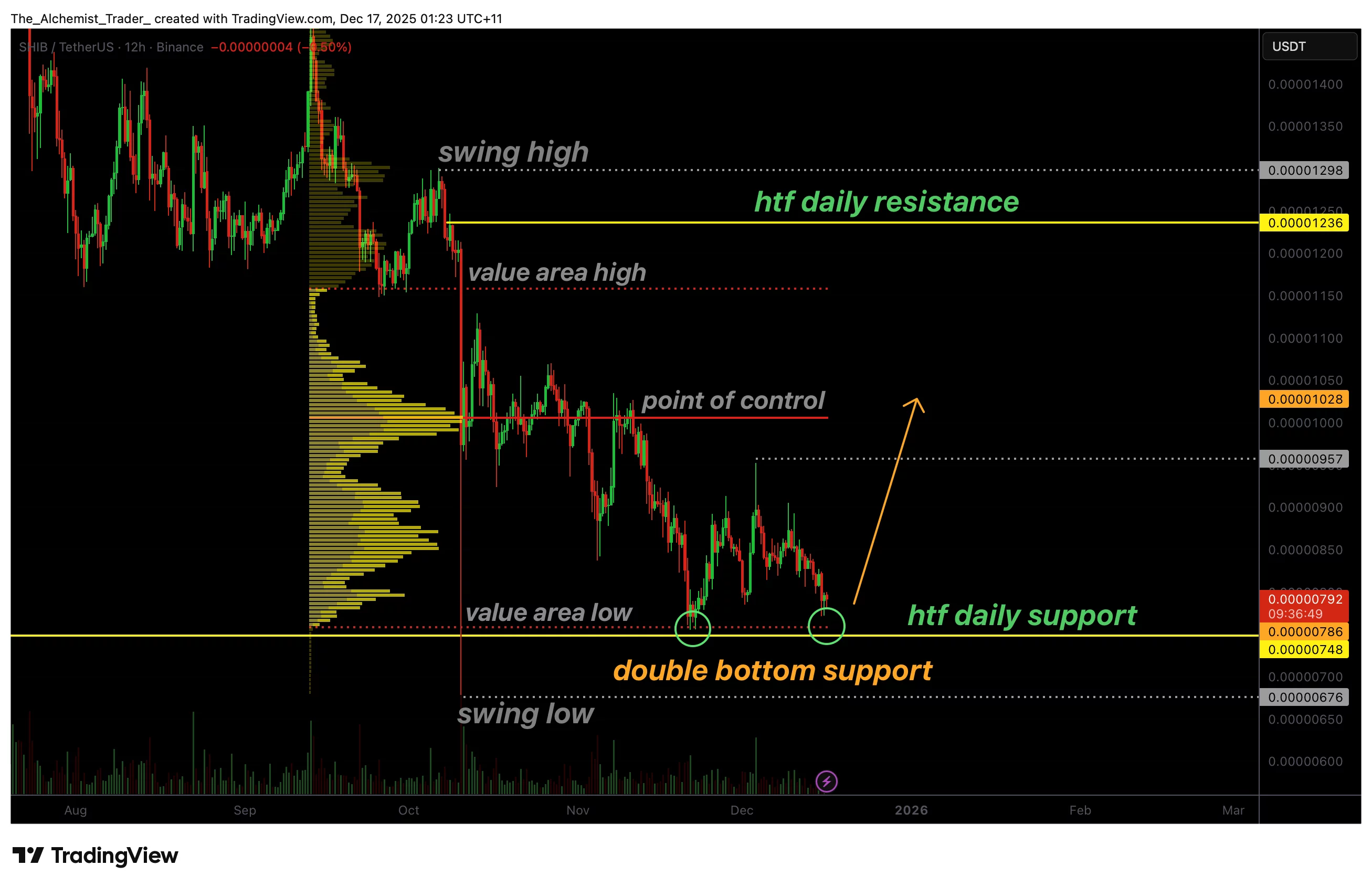
The current price action on Shiba Inu highlights a textbook environment where reversal structures tend to emerge. Price has tested the same support region twice and held on both occasions, forming what appears to be a double bottom pattern. This structure is widely regarded as a bullish reversal pattern when it occurs at major support levels, particularly those with high time-frame relevance.
What strengthens the case for SHIB is the confluence at this support zone. The double bottom aligns not only with daily structural support but also with the Value Area Low, the lower boundary of fair value within the current trading range. When price holds the VAL, it often signals that the market is defending value rather than entering a deeper price-discovery phase to the downside.
From a market-structure perspective, this area marks a potential inflection point. While SHIB remains within a broader corrective structure, the failure of sellers to push price lower on repeated attempts suggests growing exhaustion. This does not yet confirm a reversal, but it does shift the immediate risk profile away from aggressive downside continuation.
The next critical step for confirmation lies in a rotation back toward the Point of Control (POC). The POC represents the price level with the highest traded volume in the range and acts as the market’s equilibrium. A reclaim of this level would indicate that buyers are regaining control and that price is transitioning from defense into acceptance.
Beyond the POC, the Value Area High (VAH) becomes the primary upside objective. A move toward this level would confirm a market auction rotation from the lower boundary of value to the upper boundary, a classic behavior in range-based markets. Such a move would also require SHIB to break its current short-term bearish structure, signaling a meaningful shift in momentum.
However, confirmation has not yet been received. Until price reclaims the Point of Control (POC) and shows impulsive upside movement supported by volume, the double bottom remains a developing structure rather than a completed reversal.
Failed double bottoms can lead to accelerated downside, making ongoing monitoring of price behavior around support essential, even as Shiba Inu rolls out a debit card allowing SHIB spending and rewards, highlighting ongoing ecosystem developments alongside cautious technical conditions.
From a technical and price-action standpoint, SHIB is at a decision point. The presence of a double bottom at high-time-frame support offers a favorable risk-reward setup for bulls, but patience is required until structural confirmation is achieved.
What to expect in the coming price action
If Shiba Inu continues to defend the current support and reclaims the Point of Control, a rotation toward the Value Area High becomes increasingly likely. Failure to hold support would invalidate the double bottom and reopen downside risk.
